At a glance
Installing charge points is not the most complicated part of running an EV charging business. The challenge starts afterwards: keeping charge points available, monitoring multiple sites, setting tariffs, processing transactions, and helping drivers when needed. A charge point management platform brings these processes together. You can operate more efficiently, improve the experience, and expand your network without increasing manual work.
What does a Charge Point Operator do?
A Charge Point Operator (CPO) manages the technical and commercial operation of charge points. The CPO keeps charge points available, records charging sessions, sets tariffs, processes transactions, and arranges maintenance and support.
A CPO does not always own the charge points it operates. It may manage infrastructure on behalf of businesses, property owners, parking providers, or other site owners. Depending on the business model, the CPO may be responsible for one part of the operation or for the complete charging service.
Day-to-day responsibilities can include monitoring charge point status, resolving faults, managing access and tariffs, processing session data, and handling payments. Operators of publicly accessible charge points must also support roaming and ad hoc charging.
How do I get started as a CPO in the Netherlands?
You can get started as a charge point operator in the Netherlands by defining your business model, securing suitable charging sites, assessing grid capacity, and selecting a platform that can manage both charge points and financial processes.
First, decide which market you want to serve. Public charging, workplace charging, car parks, retail sites, and fleets have different users, tariffs, and operational requirements. You should then calculate the installation and operating costs, as well as the revenue each site could generate.
For each location, confirm who owns the land, which agreements are required with the site owner, and whether you need planning permission. You also need to assess the available electricity capacity. Where grid capacity is limited, load balancing, smart charging, and local energy generation can help you use the available power more efficiently.
Next, choose charge points that suit the expected use and can communicate with your management platform through an open protocol such as OCPP. You will also need to arrange installation, metering, insurance, maintenance, VAT treatment, and financial administration.
If the charge points will be publicly accessible, you must consider the European Alternative Fuels Infrastructure Regulation. AFIR includes requirements relating to ad hoc charging and price transparency. The required payment options depend on factors including the output and installation date of the charge point. You should also check with the local authority, grid operator, and Netherlands Enterprise Agency which rules apply to your sites.
What should you look for in a charge point management platform?
A charge point management platform should be reliable, secure, scalable, and compatible with the charge point brands, payment methods, and integrations your business needs.
Check how many brands and models the platform supports, as well as which functions are available for each model. These may include real-time monitoring, remote resets, cable unlocking, tariff management, and automatic fault notifications. OCPP support helps reduce your dependence on a single hardware manufacturer.
Uptime and security are equally important. An outage can result in lost revenue and frustrated drivers, while insufficient security can put company, customer, and payment data at risk. Ask how the platform is monitored, tested, updated, and protected.
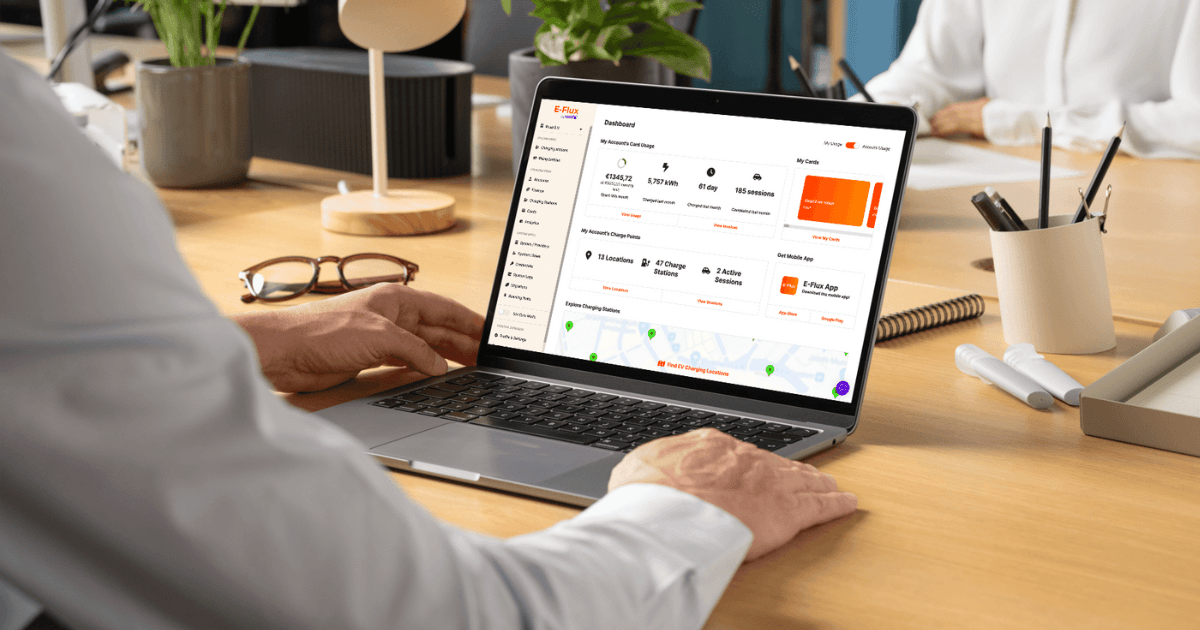
The E-Flux by Road charge point management platform brings technical management, transactions, billing, and roaming together in a single environment.
How do I manage charge points across multiple business locations?
You can manage charge points across multiple business locations through one central platform that groups the infrastructure by site, customer, or business entity. A central dashboard provides insight into charge point status, energy consumption, charging sessions, and revenue across all locations. You can apply different tariffs, access groups, and user permissions to each site. Employees, for example, can charge at a different tariff from visitors or public users.
Sub-accounts allow site owners to access their own data and invoices without seeing the rest of your network. Automated notifications show where a fault has occurred, while remote management allows many common issues to be resolved without immediately sending a technician to the site.
As the number of locations grows, reporting and API connections become increasingly important. These allow you to connect charging data with accounting software, energy management systems, and other business applications.
How do I make money from my charge points?
You make money from charge points by setting a charging tariff that covers the total cost of delivering the service and provides a sustainable margin. These costs include more than electricity: installation, grid capacity, maintenance, software, payment processing, roaming, customer support, and taxes must also be considered.
A charging tariff can include a price per kWh, a session fee, a time-based tariff, or a combination of these elements. An idle fee can encourage drivers to move their vehicles once charging is complete, making the charge point available to the next customer sooner.
Public visibility and roaming can improve utilisation by making charge points easier for more drivers to find and use. At business sites, a CPO can also generate revenue by operating charge points for the site owner in return for a fixed management fee, a fee per connector, or a share of the charging revenue.
Profitability should be measured for each location. A higher tariff does not automatically produce more revenue if it causes drivers to choose another site. Monitor the number of sessions, energy consumption, average charging time, revenue, and operating costs to understand how each location performs.
How do I settle roaming, direct, and ad-hoc payments?
You settle roaming, direct, and ad hoc payments by linking every payment to the correct charging session, customer, payment route, and tariff structure.
In a roaming transaction, the driver uses a charge card or app supplied by an external e-mobility service provider. The charge point records the session and sends the data to the management platform. The information is then exchanged through a direct roaming connection or a roaming hub. The mobility service provider invoices the driver, while the CPO is paid according to the relevant commercial agreements.
In a direct transaction, the driver or business customer has a direct relationship with the CPO. Sessions are billed through the operator’s own account, app, charge card, or customer contract.
With ad hoc charging, the driver does not need an existing contract or subscription. They can pay through a payment terminal, QR code, or online payment page. A payment service provider processes the payment, after which the management platform links the payment confirmation to the correct charging session.
A direct payment at a charge point can therefore also be an ad hoc payment. The key distinction is whether an existing customer contract is in place. An integrated platform collects the session and payment data, identifies discrepancies, and automates invoicing, VAT treatment, settlement, and payouts.
Why is customer service crucial for an EV charging business?
Customer service is crucial because a technical issue at a charge point can immediately prevent a driver from charging. Fast support reduces downtime, protects revenue, and safeguards the reputation of both the CPO and the site owner.
Drivers may need help when a charging session fails to start, a charge card is rejected, a payment cannot be completed, or a cable remains locked. Installers and on-site technicians may also need support with configuration, connectivity, and fault diagnosis.
You should therefore check which support services a platform offers, which channels are available, and what happens outside office hours. It is important to distinguish between 24/7 self-service, automated monitoring, and telephone support. E-Flux by Road offers 24/7 self-service support for drivers and telephone support during office hours.
How can E-Flux by Road help?
E-Flux by Road brings charge point management, transaction processing, billing, payments, and roaming together in one platform. From a central dashboard, CPOs can manage multiple locations, set tariffs, monitor charge points, and resolve common problems remotely.
The platform supports different charge point brands and can scale with features such as sub-accounts, reporting, tariff profiles, and API access. This keeps both the technical and financial operation manageable as the charging network grows.

13 March 2024
Everything you need to know about smart charging
Energy management, also known as smart charging, is an umbrella term for various technologies, methods and solutions for managing electricity in an intelligent way. There are different levels of sophistication of energy management solutions, and these will depend on the customer’s needs and infrastructure.
22 December 2023
EV charge management cybersecurity
As charge point operators, our systems are responsible for the flow of energy to EVs. This is an exciting and relatively new area of technology. This also means that as charging networks grow in size, the amount of electricity controlled by charge point operators could become significant enough to influence the energy system.